Ken Burns’ new PBS documentary depicts public housing in America as a racist institution that has kept society’s most marginalized people segregated, silent and in a perpetual state of poverty.
The voiceless families who have long suffered at the hands of state and federal housing authorities have been granted a voice to share their stories in the film.
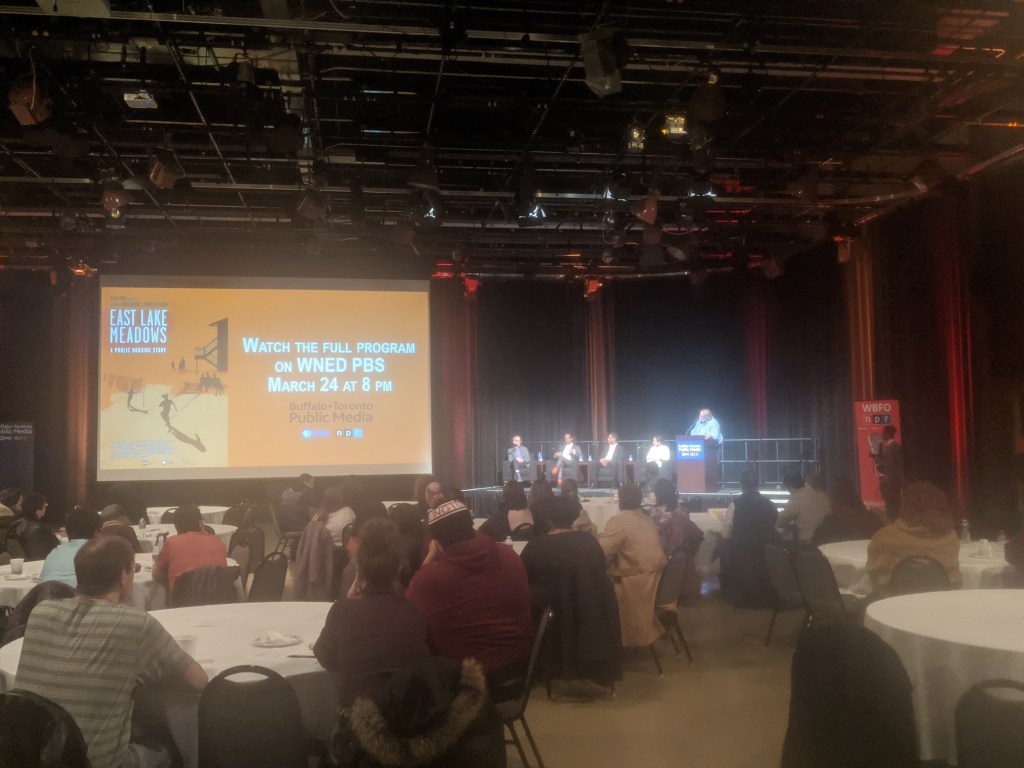
On Wednesday, PBS affiliate WNED hosted an abridged screening of its new documentary “East Lake Meadows: A Public Housing Story”. The film details how African Americans have been historically forced into concentrated poverty areas and how the United States government has done little to remedy the situation. This story, which rings true in Buffalo or any city in America, is told through the recounts of past residents of East Lake Meadows in Atlanta – a 650 unit public housing complex. Roughly 100 viewers attended the screenings in WNED’s banquet center.
The film follows the history of East Lake Meadows from its construction in the 1970s to its crime-ridden and unkempt existence in the 1980s and 1990s, when it was referred to as “little Vietnam”, until its demolition in 2005. After the complex’s destruction that forced out residents, many families weren’t allowed back into the newly constructed village in favor of higher income white families, after being promised by housing officials they could return.
In addition to highlighting the poor quality of living and racism low income minorities face in public housing, “East Lake Meadows: A Public Housing Story” raises questions about how we can prevent similar situations in the future.
“I think there are stigmas that are attached to the people who live in public housing. I think that’s true in Atlanta and true everywhere,” said David McMahon, creator of “East Lake Meadows: A Public Housing Story.” “ So our efforts with the movie were to find people who could tell their stories. You could tell it as a story about statistics, or you could go and put a human face on it.”
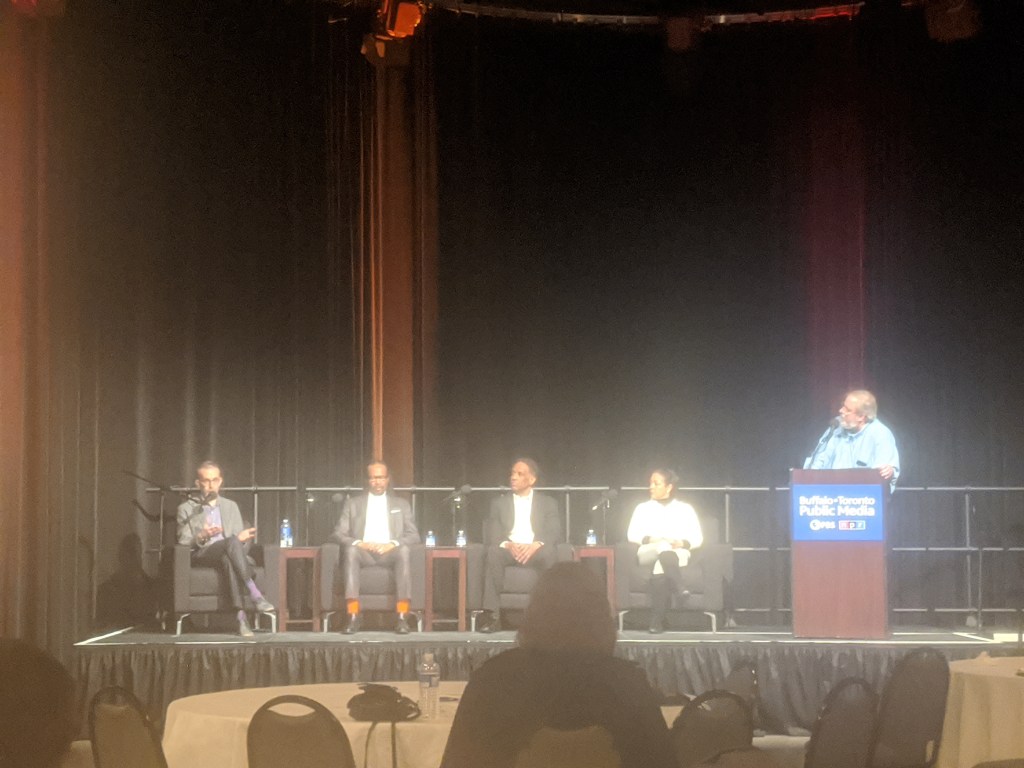
After the 45 minute screening, a panel consisting of McMahon, Dr. Ron Stewart (Buffalo State Sociology Department Chair), Ronaldo Graham (BMHA 10 Council) and Veronica Hemphill Nichols (founder of the Fruit Belt, McCarley Gardens Housing Task Force) spoke about the film and how it relates to public housing in Buffalo.
Nichols described how low income families in Buffalo are currently being similarly forced out of their housing through gentrification.
“[McCarley Gardens] ownership in the past has tried to sell McCarley Gardens to UB, which took us four years to fight them and push them back,” Nichols said. “ Right now in Pilgrim Village there are systematic evictions, illegal evictions. The tenants are too afraid to step forward.”
The tragic story of East Lake Meadows is not unique to the past or Atlanta, as gentrification and unjust treatment of minorities is still commonplace in America.
“When it comes to these developments, this is what they want to do. When you talk about tearing down East Lake Meadows, that happened with Town Gardens [in Buffalo],” Nichols said. “They tore all of it down and built some beautiful units, you know, and only a fraction of the former tenants were able to come back.”
The events depicted in the film point to lingering racial issues in America.
“I do think the movie is sort of like a microcosm of what is happening in America,” Stewart said. “It is seemingly a national policy that people in power, particularly I would say white males, get in a room and decide what they want to do with people of color.”
Ultimately, “East Lake Meadows: A Public Housing Story” exists to set the record straight by providing viewers with the truth from marginalized and silent groups.
“So often the people who have the largest megaphone, and the deepest pockets are the ones who get to tell the story. And that’s how the narrative gets shaped, and those narratives get embedded, and then that becomes history, and that becomes what’s taught,” McMahon said. “It’s important to us that we go back and look at a story and say, ‘whose voice hasn’t been heard?’”
According to the storytellers and experts in the film, as well as the panel at Thursday’s screening, gentrification, racism and white greed are still rampant in cities across America.
“The parallel is just so amazing,” Nichols said. “It’s happening to us right now, we’re in the midst of this battle. Honestly, I’m not going to accept that outcome for Buffalo.”
“East lake Meadows: A Public Housing Story” will be broadcast in its entirety on Tuesday, March 24 at 8pm on WNED PBS, according to WNED’s website.
 The Pointless Blog