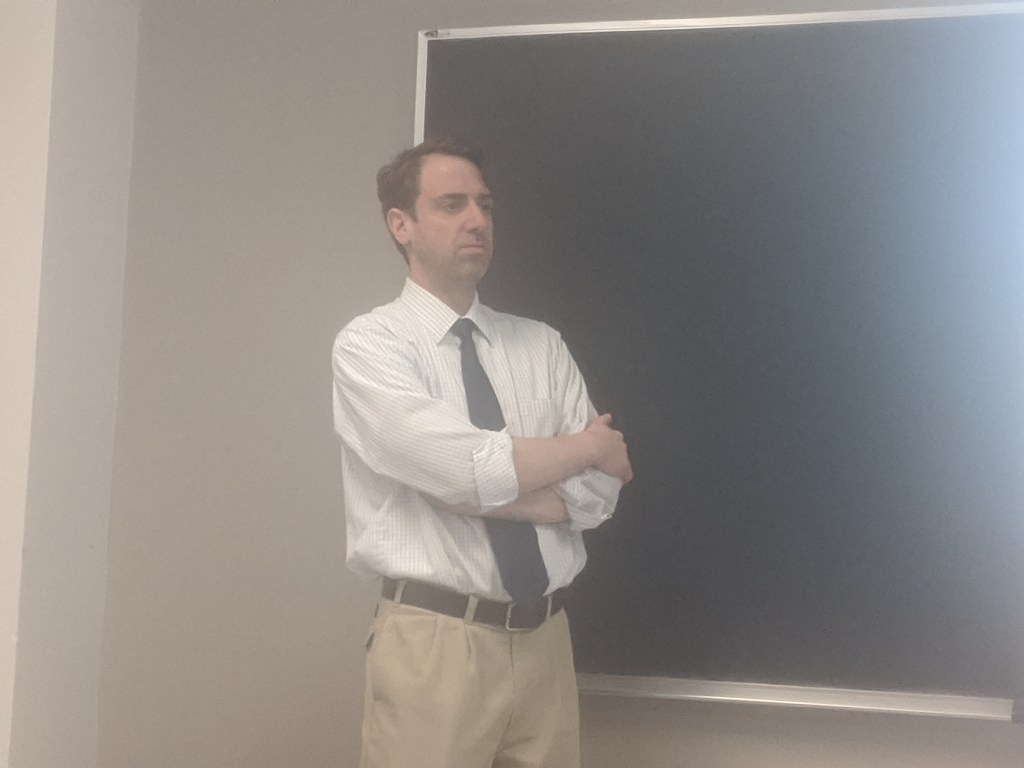
Brutal, unsettling and unthinkable crimes occur everyday in Buffalo, and someone has to go to the scene to report on them.
That someone is Aaron Besecker, a criminal justice and breaking news reporter at The Buffalo News.
Besecker, a Western New York native and 2002 University at Buffalo graduate, started his journalism career with Niagara Falls’ newspaper The Niagara Gazette in 2004, where he covered news in Lewiston, NY. In 2007, he moved to The Buffalo News where he quickly found his journalistic calling working the crime beat.
“Everyday is different and I definitely don’t get bored with it,” Besecker said. “I think that I am lucky to have a job where I like, really just love it.”
Reporting on criminal justice and breaking news is Besecker’s dream job, but many of the stories that he reports on would make the average Joe cringe, cry or quit. This line of work is not for the faint of heart.
Besecker is often sent to the scenes of gun violence, homicide, suicide or any other gruesome crime that occurs in the city and surrounding areas of Buffalo. Not only does he witness the unsettling crime scenes, but he speaks with the victims’ friends and family during which Besecker describes is “the worst day of their life, or close to it.”
“Sometimes you talk to people who’ve had their children killed or other loved ones horribly injured,” Besecker said. “So you have to take care when you approach people and ask them questions.”
It is only human to be affected by the things that Besecker sees, or the heartbreaking statements he hears from the people he interviews. But to be effective and objective, a journalist must not allow their emotions or bias to slip into a story. Besecker empathizes with the subjects of his reporting while remaining emotionally distant from them to ensure that his stories are nothing more than facts.
“I’ve become better at staying apart from the subject matter,” Besecker said. “There’s some pretty devastating stuff that happens, you know? Like, it takes a lot to make an impression [on me] nowadays.”
Occasionally though, a story will hit The Buffalo News’ crime desk that is so heinous, even a seasoned veteran like Besecker finds it difficult to leave his emotions at the door.
“A couple months ago there was the trail of the girl who got burned outside of Tim Hortons by her boyfriend. She was, like, horrifically burned,” Besecker said. “She was in court testifying… And it was really just tough.”
One way Besecker keeps himself sane while dealing with his job’s heavy subject matter, is by not taking his work home with him. Besecker uses his days off to decompress and relax.
“You’ve got to balance it. I couldn’t do my job and never turn it off when I get home,” Besecker said. “I work hard when I’m [at work] and when I’m not there, if I hear something I’ll let an editor know or someone else know who’s [at work]. But I just can’t, it’s not good personally to always work.”
While Besecker loves his job at The Buffalo News, he recognizes that journalism and journalism careers have been on a steady decline for many years.
“There are a lot fewer jobs than there used to be,” Besecker said. “ When I got hired by The Buffalo News [in 2007], my editor said she thought that I would be the last full time reporter hired by The Buffalo News. That turned out to be true.”
Despite the brutal crimes Besecker covers on a daily basis and the future of journalism being uncertain, his passion for his line of work continues to motivate him.
“The greatest satisfaction is when you write a really good story. Just that feeling, that is what drives me,” Besecker said. “I don’t want to think about [changing careers]. I want to stay in journalism.”
 The Pointless Blog